Do I need to be a birth doula before I train as a postnatal doula?


No, you don’t.

You don’t need to have supported a single birth. You need to want to walk with families through those early weeks after birth, and you need the right training to do it well.

Postnatal doulaing is the forgotten part of birth work. Not forgotten by families but by the system, and by the training routes that put it second.

Why do people think they need birth training first?


You may never have done any doula work before, but you find yourself pulled by what happens after birth. You want to be what families need in those weeks: their mother without the politics. You want to nurture and nourish people, because you can see that’s what’s missing after birth. Yet somehow you’ve managed to pick up the belief that you need to do birth training first. 

That can come from the way training is set up. I’ve done it too. Postnatal doulaing isn’t the second half of birth work. It’s its own work, and I train it that way. What can happen is that you invest in training that you’re not going to use, so that you can get to the bit that you actually want to pursue. What can also happen is that fewer families are served because fewer people are trained, and this matters because that early postnatal period can really affect what the ongoing postpartum looks like.

I remember a client with twins that I was supporting, and her partner had a very little leave and they had no family close by. Their health visitor told them that they needed to be careful of the voices that they listened to and that hers was the only one that mattered. Then she told them she was going on leave for two weeks. What this client needed was someone that she knew would be with her as she navigated feeding two babies, feeding herself and how she managed her day to day, including getting rest whilst responding to their needs. Nobody notices this once family and health professionals have gone. Nobody.

So what is a postnatal doula?

Someone who walks alongside a family through the postnatal period. They hold, nurture and nourish the person who has given birth, helping them listen to their instincts, or learn them, about what they want and need. Some postnatal doulas are fully hands on, cooking and helping with basic household tasks. Some keep an eye on rest, infant feeding and the mental load. Most do a combination of it all. In practice, you arrive, pop the kettle on, check who has and hasn’t eaten, and put the dishes away. You bring peace and a sense of order to what can feel chaotic or overwhelming. You make breakfast, or even second breakfast (got to love the hobbits), and keep an eye on the baby or babies so your client actually gets to eat.

You’re not too young, too old, nor do you need a medical background to do a postnatal doula course. You don’t need to be a caterer or a professional cleaner. These aren’t required skills. Not many arrive with experience, which is what the training is for. In Abuela Doulas training, we gather the stories and experiences of the group and build our pictures of what a postnatal doula looks like and does. The work is different to what a birth doula does, and whilst knowledge of how birth works is important, that’s something that we also cover in the training.

Families want your time. They don’t want you taking over, and they need to know you’re not running your own agenda. You’ll be there as part of their support team, not, for example, telling them which method of infant feeding they should be following. You’ll recognise what is tiredness and what is not. You’ll know when to refer to other services eg perinatal mental health, drop in groups, lactation support. When the initial flurry of visitors and help fades, you’ll be there, holding your client.

" You want to be what families need in those weeks: their mother without the politics."

What is Sankofa?

We talk about Sankofa, going back to retrieve knowledge, culture, tradition, customs. Here in the UK so many traditions have been lost. It’s not that they were never here, it’s just that we don’t talk about them and they have faded from memory. So many other cultures have rest built into the postpartum and the UK doesn’t, on the whole. We can be so keen to ‘get back on with things’ that we lose these moments of rest that set us up for optimal recovery.

It used to be that there was a lying in period. In fact, the first time a new parent ventured out was to present the baby at church. It was called churching, a Christian ceremony that blessed and thanked a mother after she had recovered from having a baby. Churching marked the end of the lying in period and welcomed the mother back to church and life. This happened about six weeks after a birth, and the last remnants are seen in the six week postnatal visit to a GP. You’re not there to bring back churching. You’re there to bring back what sat underneath it: rest that’s expected, protected, and held by someone other than the person recovering.
What do you learn on Postnatal Sankofa?

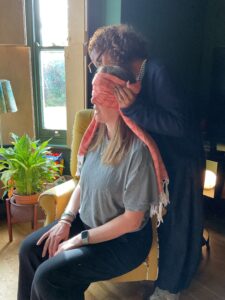
Postnatal Sankofa is a postnatal doula training course run over four days, in North London, with Rubí Rodríguez-Nieto, and you don’t need to have trained as a birth doula to be in the room. Two of those days are hands on. You learn the traditional practices the postnatal world keeps rebranding as new, from around the world and from your clients’ own heritage: closing the bones and belly binding, baby carrying, healing foods and oils, and the 40 day lying in. All of it is taught whilst holding your own heritage.

You learn feeding support at the level a postnatal doula actually needs, and the skill that matters more: knowing when to signpost and who to signpost to. You build postpartum plans with families using the Five Anchors. You learn boundaries: where your role starts and stops in someone’s home, and what to do when the person you’re supporting is being dismissed, because for Black and Brown families that isn’t a side issue. It’s a safety issue. You also leave with the practical side covered, so you know how to set yourself up to do this work. This isn’t training in jobs and doing. It’s training in nurturing, nourishing and valuing the people who birth babies. You also join the wider Abuela Doulas community and get a lifetime listing on our directory.


What do you actually need?

So no, you don’t need to be a birth doula first. You need curiosity about families. You need to be able to stay in someone’s home without fixing it. You need to be willing to look at how race and culture shape the care people get, and the care they don’t get. And you need four days.

Families are sent home and left to it. The forgotten part of birth work only stays forgotten if nobody turns up.

Mars Lord, founder of Abuela Doulas, 22 years in birthwork

Postnatal Sankofa runs 3 to 6 November 2026. Booking closes 30 October and there are six places left. If November doesn’t work, the next cohort is 19 to 22 January 2027.

The Abuela Doulas newsletter.
What’s happening in birth, what the reports aren’t saying loudly enough, and when the next cohorts open.

[convertkit form=8133542]

Charity Links

Abuela Doulas recognises that as well as doing the work, they need to support the work of others. With that in mind, here are some links to support not only us, but other organisations that we are involved in.

Follow Us!

© Abuela Doulas 2026

Designed and created by Entrepreneurial Alchemy